
Modernizing a Policy-to-Pricing Workflow for Medicare Fee Schedules
Sanitized UX case study focused on translating complex policy updates into clearer, more scalable workflows
Role: UX / Service Designer
Context: Public policy, internal systems, data modernization
Users: Policy analysts, technical analysts, contractors
Focus: Workflow analysis, service design thinking, user experience research, future-state design
Outcomes:
This engagement produced a service design roadmap that directly addressed the core challenge: Medicare fee schedule updates were trapped in an aging mainframe infrastructure, requiring manual interpretation and coordination across dozens of contractors to implement correctly.
Working from user needs surfaced through workflow walkthroughs and stakeholder interviews, we defined 9 modernization capabilities to eliminate the downstream dependency on the mainframe. The roadmap addressed approximately 1,424 pricing files spread across shared systems — each one representing a manual handoff risk and a source of potential error in the payment ecosystem.
Key capability areas included:
Consolidating fragmented pricing files into a unified cloud database, replacing a patchwork of mainframe dependencies with a single source of truth
Migrating 72 HCPCS code files into a single cloud-hosted database, eliminating redundancy and reducing reconciliation burden
Automating the generation of public use files, removing the manual step that required Policy staff to produce them on each update cycle
Moving fee schedule calculations directly into the cloud environment, removing the SaaS intermediary layer
Enabling Medicare Administrative Contractors (MACs) to draw pricing directly from cloud-hosted reference files, eliminating their dependency on contractor-managed mainframe data
The broader impact: The roadmap gave leadership a concrete, sequenced path from the current fragmented state to a scalable, traceable system — grounding modernization planning in real user pain points rather than purely technical ambition. Stakeholders across policy, technical, and contractor teams reached alignment on the existing workflow's limitations and a shared framework for future-state improvements.
Context
Medicare fee schedules are updated regularly based on policy changes that affect how healthcare services are coded and reimbursed. These updates must be accurately interpreted and communicated from policy documentation to multiple downstream contractors responsible for implementation.
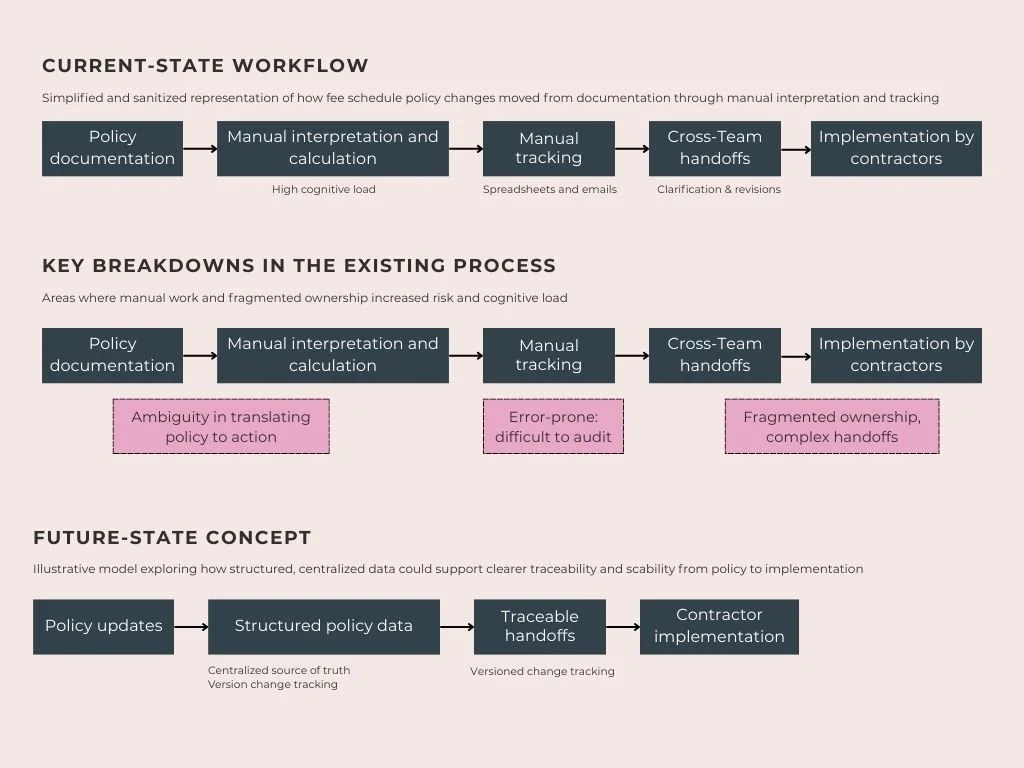
This project focused on understanding and improving an internal workflow used to track fee schedule coding and pricing changes as they moved from policy to operational systems. The existing process relied heavily on manual interpretation and coordination, creating challenges around accuracy, traceability, and scalability.
The Problem
Policy updates were authoritative but not implementation-ready.
Users were required to manually track, interpret, and reconcile changes across documentation, spreadsheets, and communications. Much of the process relied on institutional knowledge, increasing cognitive load and introducing risk when timelines were tight or staff changed.
As policy complexity increased, the workflow struggled to support transparency, consistency, and confidence across teams responsible for carrying changes forward.
My Role
I worked as a UX / Service Designer embedded within a cross-functional modernization team. My role focused on understanding the end-to-end workflow, identifying breakdowns between policy and implementation, and helping articulate future-state concepts for a more scalable, data-driven approach.
I collaborated closely with policy subject-matter experts, engineers, and analysts to synthesize findings and translate complexity into shared understanding.
Research & Discovery
Research centered on sensemaking rather than interface usability.
Methods included:
Reviewing publicly available policy documentation
Workflow walkthroughs with subject-matter experts
Stakeholder interviews across policy and technical roles
Process mapping to surface handoffs and pain points
Rather than a single “user,” the work revealed a system where humans acted as the connective tissue between policy and implementation.
Key Insights
1. Policy documentation was authoritative but difficult to operationalize.
Users spent significant time interpreting how policy language translated into concrete coding and pricing changes.
2. Humans were compensating for system gaps.
Manual tracking, spreadsheets, and memory filled in where tools lacked structure or traceability.
3. Traceability mattered as much as accuracy.
Users needed to understand not just what changed, but why and where it came from.
4. Workflow clarity was fragmented across teams.
Different roles held partial views of the process, making coordination difficult.
Design Opportunity
The opportunity was not to redesign screens, but to redesign information flow.
Design goals focused on:
Making policy changes more structured and traceable
Reducing reliance on institutional memory
Supporting clearer handoffs between teams
Enabling future scalability through data-driven workflows
Why Information Flow, Not Interface Design
It would have been easy to approach this project by designing a new dashboard or interface for analysts. But our research made clear that the problem wasn't how information was displayed — it was how it moved (or failed to) between policy documentation, internal systems, and downstream contractors.
Designing new screens without first fixing the underlying data flow would have been cosmetic. We chose to focus on service design: mapping the full workflow, identifying where manual effort compensated for system gaps, and defining a future state where traceability and accuracy were built into the system rather than dependent on individual expertise.
This decision was reinforced by the federal context: in a system affecting Medicare payment for millions of beneficiaries, precision and auditability weren't nice-to-haves. They were the design brief.
Future-State Thinking
We explored how cloud-based data structures could support a clearer, more transparent flow of fee schedule updates from policy to implementation.
Conceptual models emphasized:
Centralized sources of truth
Versioning and ownership of changes
Clear lineage from policy language to operational outcomes
Reduced manual reconciliation
These concepts informed modernization planning while remaining adaptable to technical and regulatory constraints.
Outcomes
This work helped align stakeholders around a shared understanding of the existing workflow and its limitations. The resulting artifacts supported modernization discussions and provided a clearer foundation for future system improvements.
Reflection
This project reinforced that UX extends far beyond interfaces—especially in policy-driven environments. Designing for accuracy, traceability, and confidence required deep respect for complexity and constraints. I learned how critical it is to design systems that support human decision-making rather than relying on it. The experience strengthened my ability to translate ambiguity into structure and to advocate for user needs in environments where trust and precision are paramount..